
Words by E.J. Milner-Gulland, University of Oxford and Saiga Conservation Alliance
In May 2023 I was honoured to be part of an expert mission to support the Government of Kazakhstan in developing a new strategy for the conservation and management of saiga antelopes. The strategy was prompted by the continued rapid increase in saiga numbers over the last few years, in all of Kazakhstan’s populations. We were particularly focussed on West Kazakhstan, where the Ural saiga population has now reached around 1,130,000. Considering that the estimated saiga population in that area averaged around 375,000 in the 1980s, and that it reached a low point of an estimated 6,500 only 20 years ago, this is an extraordinary recovery. However, with this success have come other challenges, and in particular concerns from farmers and livestock owners that large herds of saigas are damaging their crops, hayfields and pastures, and that they are competing with livestock for limited water and potentially spreading disease. These concerns have become particularly acute in the last 2-3 years.
Our expert group included specialists in landscape ecology, spatial planning, community conservation, sustainable hunting, and saiga ecology (Michele Bowe, Norbert Hölzel, Tamas Marghescu, Stefan Michel, me, Navinder Singh, Steffen Zuther), as well as representatives of the Convention on Migratory Species and CITES (Hyeon Jeong Kim, Clara Nobbe, Polina Orlinsky). We were first invited to West Kazakhstan to witness this situation first-hand, and several of us were able to make this trip. After a long journey we reached a petrol station outside the village of Kaztalov. There we were met by rangers from Okhotzooprom, who told us that a large group of saigas was on the communal grazing lands on the outskirts of the village, only a few hundred metres away. The sight was extraordinary and very emotional for me, as someone who has been working for saiga conservation for several decades. In my rare trips to the saiga range I have in the past seen a few tens or hundreds of saigas, often fleeing over the horizon. This time, a huge group of several thousand females and calves was grazing calmly outside the village, bisected by a road and watched by our convoy of vehicles and other road users. The calves were playing together and every now and again a group of saigas calmly crossed the road close to our vehicles. They were clearly not worried by human presence.
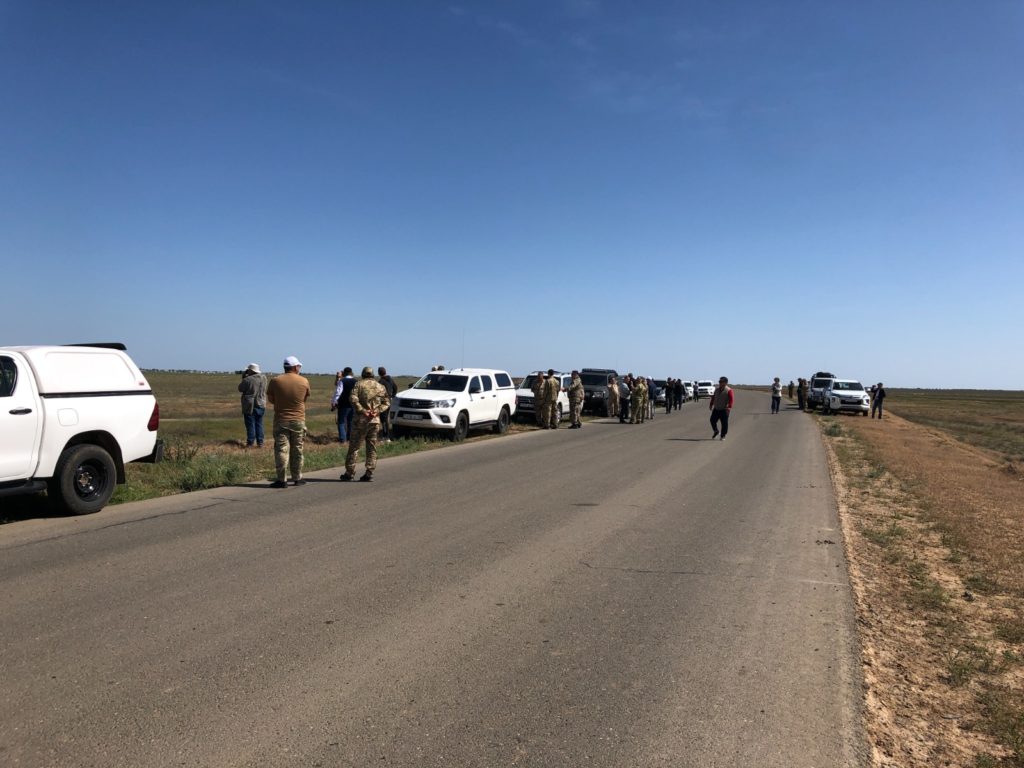
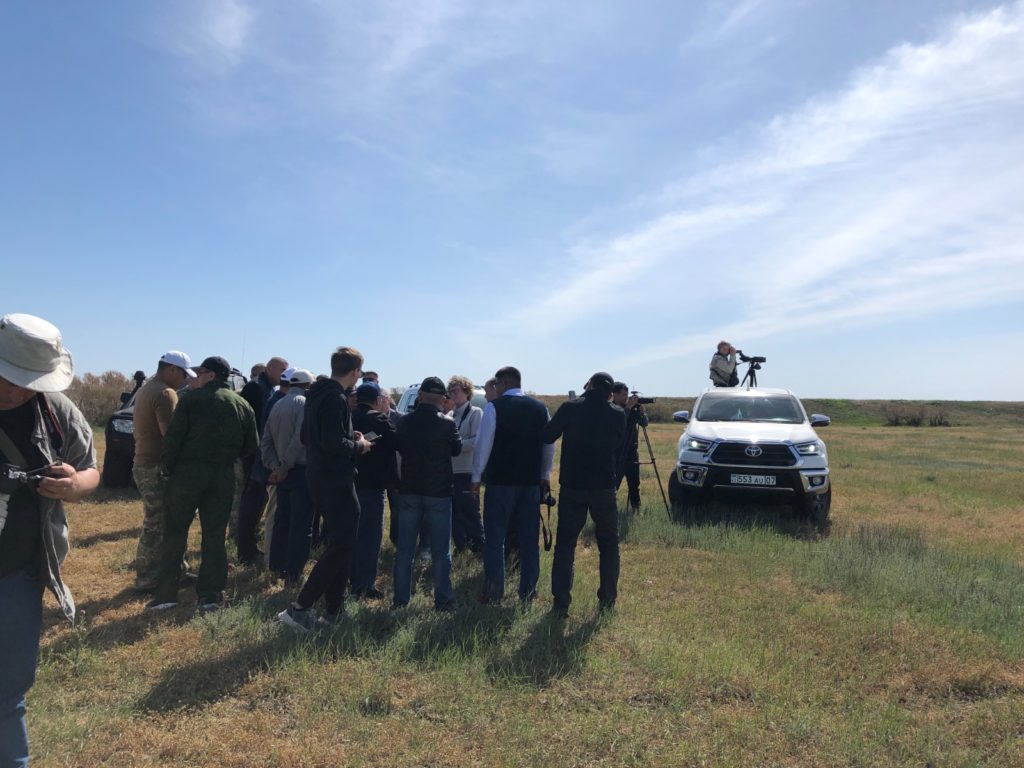

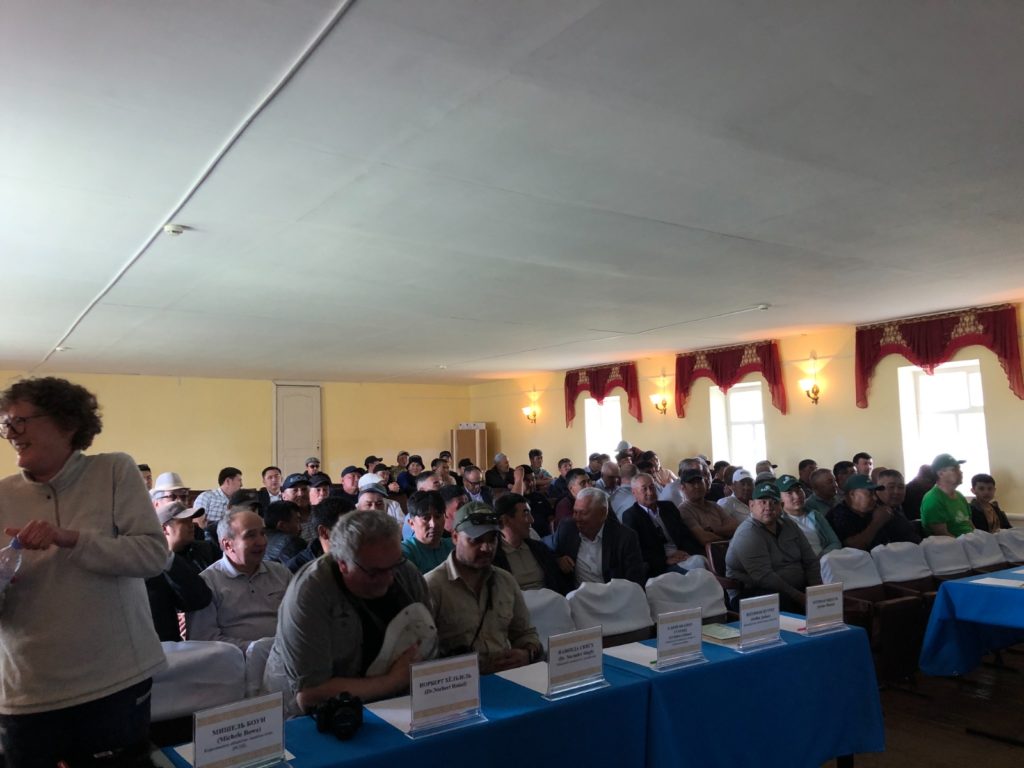
This sight was a clear demonstration that all the hard work to conserve saigas by the government, NGOs and the international community had finally paid off. Talking to farmers and their representatives, however, it was obvious that this huge saiga resurgence was not universally welcomed. Although farmers saw the value and importance of saigas as part of their natural heritage, they felt that in large numbers saigas caused substantial damage by eating crops and grass, drinking water meant for livestock, trampling crops or hayfields and spreading disease. At the moment they feel powerless to act to protect their lands (it is not allowed to drive saigas away), and angry and frustrated that their concerns have not been acted upon.
Our trip prompted many questions. This area has seen huge changes in land use over the last decades; much of the land was ploughed up for wheat in the 1950s as part of Khrushchev’s Virgin Lands campaign. In the 1980s the saiga was quite heavily exploited for meat and other products and kept at levels well below carrying capacity. Then the break-up of the Soviet Union in the early 1990s caused the collapse of both livestock and saiga numbers, drastically reducing grazing pressure and causing vegetation to grow higher and denser. Now numbers of both are increasing, and water is becoming an increasingly scarce resource for various reasons, including extraction for growing towns and cities. The Kazakh government is already meeting shortages by paying the Russian government for water diverted from the Volga river. These dynamics are playing out in a complex way over a large area. Disentangling the relative roles of precipitation and grazing in vegetation growth in the context of the use history of an area is quite a challenge, and our experts spent some time “reading” the species composition of the vegetation and wildlife and linking this to remotely sensed images, so as to guess at how a particular area might have evolved.
Looking into the future, a sustainable balance needs to be reached in a way that is equitable, supports productive farming and livestock keeping, while also conserving and enhancing this unique landscape and its nature. This requires both short- and long-term actions over small to large scales, and the involvement of local communities in determining the way forward. Our role was to provide advice and support to realise this vision; spending even just a few days actually observing the situation and talking to local people was invaluable.
It was also a great treat for me and several other experts who have not had the opportunity to get out into the steppe for some years; to smell the wormwood, see birds, plants and other wildlife, as well as healthy livestock with their babies, and walk in the open air brought back so many good memories and made us very happy. The whole steppe was bursting with new life and the experience underlined again why this landscape is so special. We also enjoyed the hospitality of our hosts in the villages and appreciated the open way in which they talked with us about the issues they were facing. We came at a time when the livestock were producing new milk and so we enjoyed eating thick cream and homemade butter along with the region’s traditional dishes.
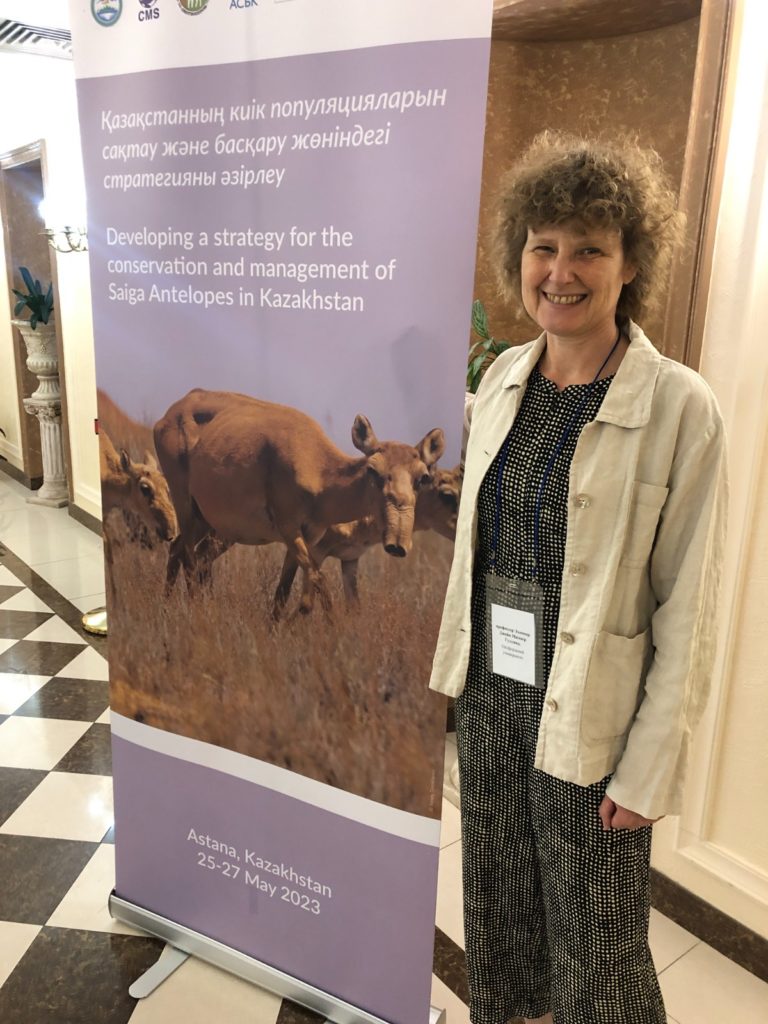
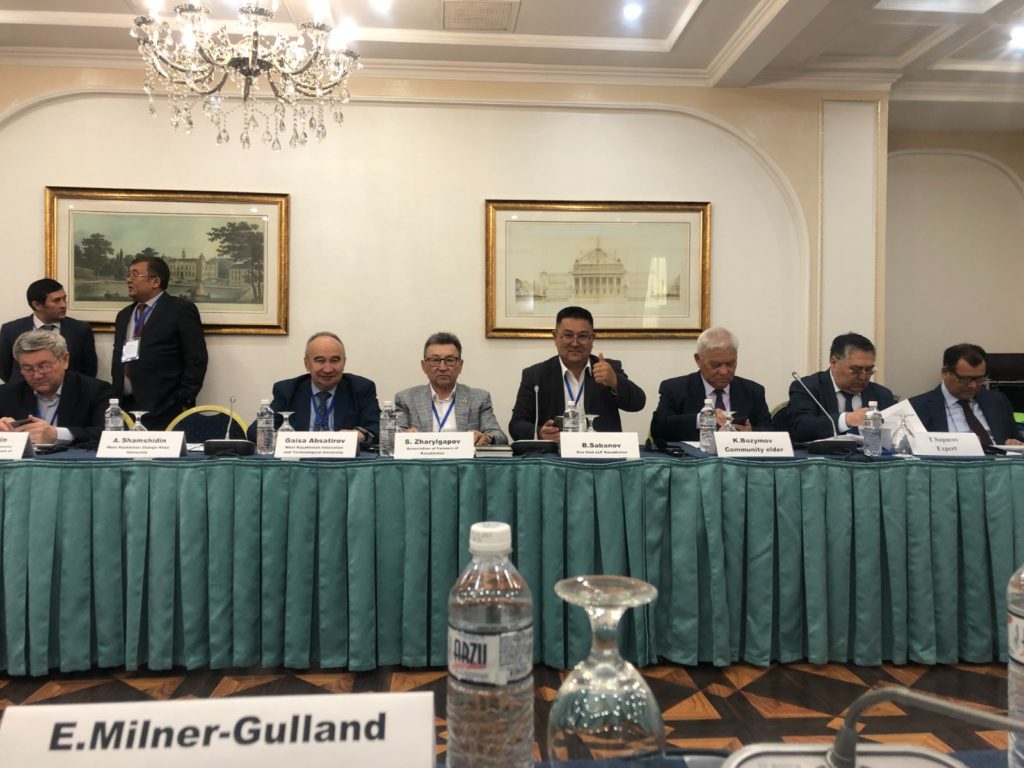
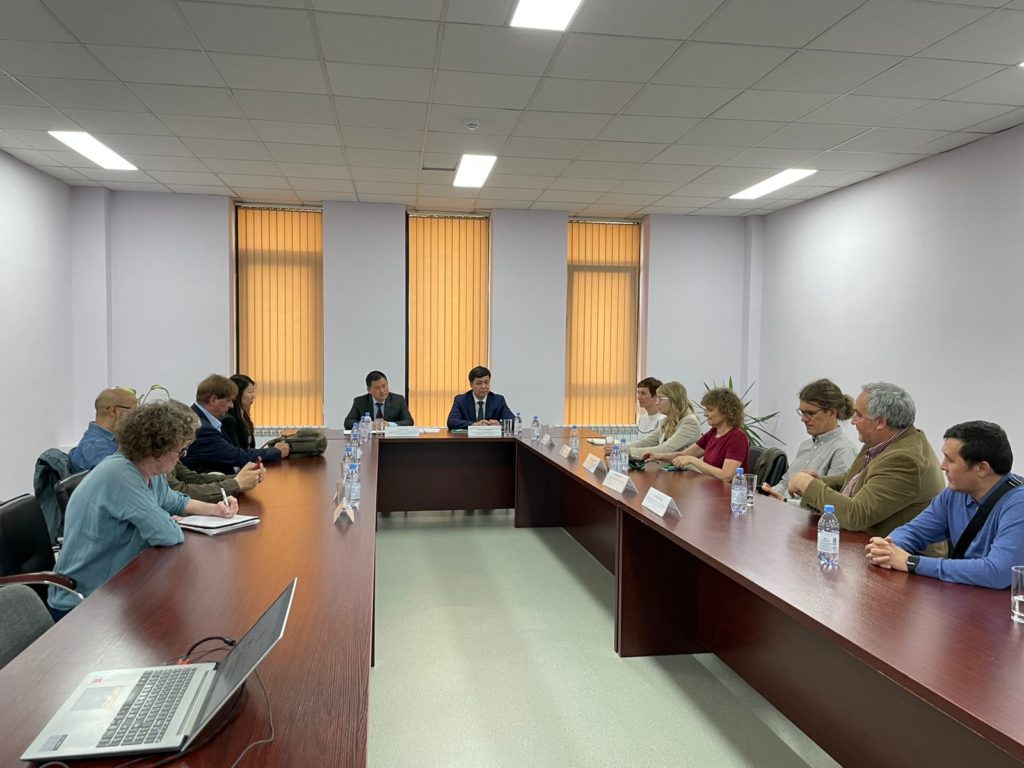
After our fieldtrip we participated in a three-day meeting in Astana which was organized by the Secretariat of the Convention on the Conservation of Migratory Species upon the request of the Government of Kazakhstan and with funding received from the Government of Germany. It involved all the relevant stakeholders, including the Committee on Forestry and Wildlife, Okhotzooprom, farmers’ representatives, research institutes, UNDP and hunting associations. They were gathered to agree on a detailed strategic action plan covering all aspects of saiga conservation, management and sustainable use for the whole country. Debates were sometimes heated but were underpinned by a shared understanding of what the issues are, and agreement on the overarching goal of coexistence between people and saigas in a way that supports both prosperity for local communities and a long-term future for recovered saiga populations.
At the beginning it felt like an almost impossible task to get through a long and detailed document and agree every one of 24 action points, each of which had several sub-actions, as well as listing the stakeholders involved in implementing each one and its time-frame. People had come with their own priorities and solutions and felt the need to be heard. However, over the course of the meeting our views became more aligned and we moved more quickly, producing in the end a strategy that everyone felt proud to be associated with. This includes the sustainable use of saigas to generate revenues from meat and horns, generating conservation incentives for local communities to coexist with saiga, supported by long term land-use planning at the landscape level.
We should also not forget the potential for tourism. The huge herds of saigas we witnessed could be a great draw for people, alongside the culture and other wildlife of the Uralsk region. We had the privilege also to spend a day in the Korgalzhyn Reserve in the Akmola region between our field trip and the main meeting, where the birdlife is outstanding but which also hosts saigas from the Betpak-dala population, including for mass calving. We saw a few herds including one of several hundred animals, albeit further away than in West Kazakhstan, as well as impressive waterbodies including Lake Tengiz. This is an area which already has some tourism which can be built upon. In this region the saiga population has also dramatically increased and there are complaints from farmers that they trample their crops, particularly just before harvest. However, the area where they roam is less constrained and so the issues are currently less acute.
The next stage is to find the resources to enable the conservation and sustainable use strategy to be implemented, starting with a few “quick wins” and pilot projects to build trust and help farmers cope with large saiga numbers on their land in the short term, while the longer-term structures are put in place. It’s important that local people don’t end up feeling that this was just another talking-shop, but that it is the start of a new partnership for genuine change. There are a number of other hurdles, including the Parties to CITES agreeing to allow sustainable horn trade once again, which will require sustained effort and international consultation to achieve. Legislative change at the national level is also needed to support implementation of the strategy.
The international experts emphasised throughout that Kazakhstan should feel huge pride in their achievement of saiga recovery – right down from the national-level Committee on Forests and Hunting to every community living in the saiga range. There is an opportunity here to lead the world in sustainable and participatory management of a species and its habitats at a grand scale; my impressions of our trip suggest that Kazakhstan is ready to take this opportunity. I’m sure I speak for every one of the international experts who were part of the trip, in saying that I stand ready to help and support however I can.