
About Saigas
What is a saiga?
An extraordinary antelope that has roamed the Eurasian steppe since the Ice Age. Discover what makes saigas unique, how they live, and where they are found today.
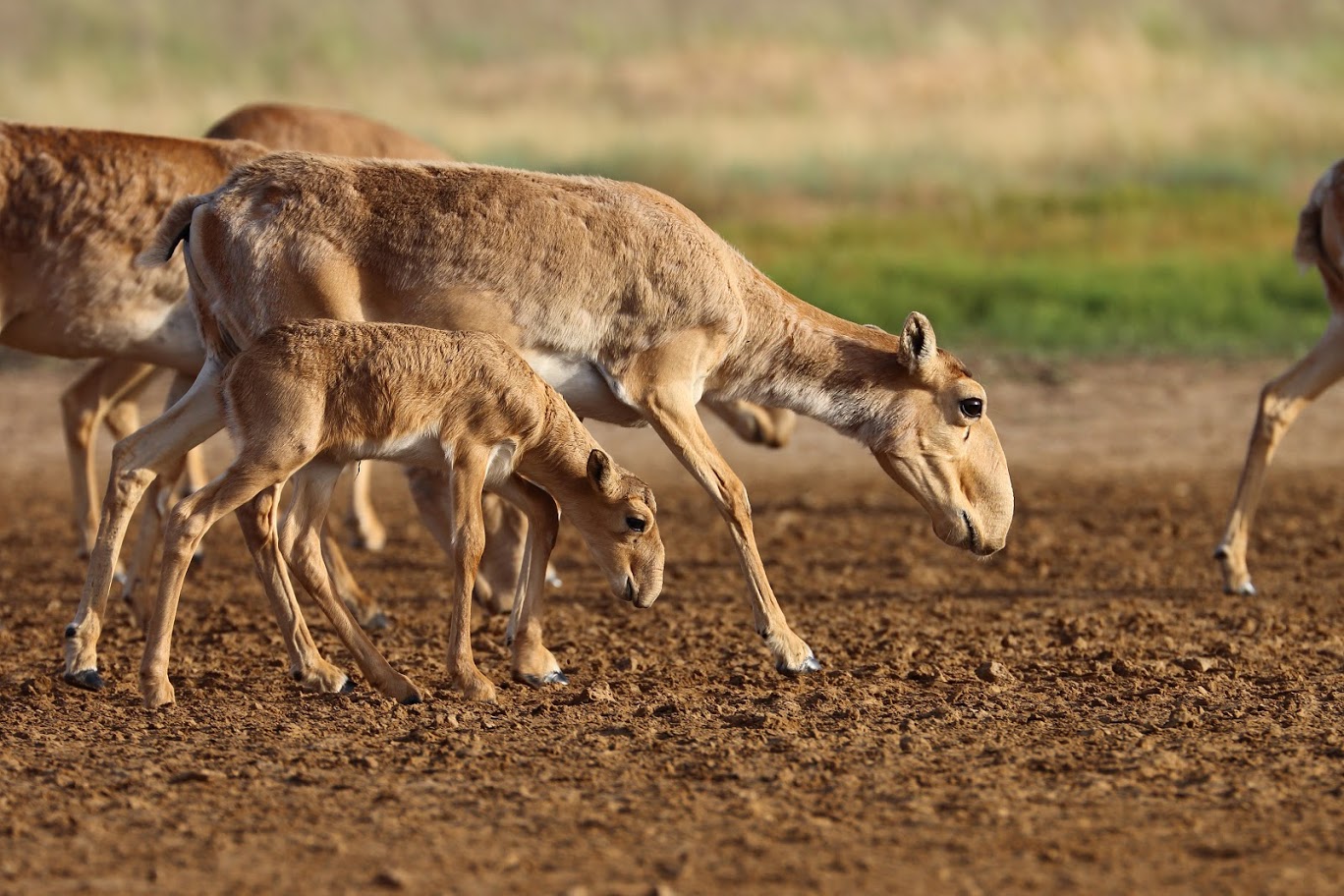
Saigas are migratory antelopes native to the open steppes and semi-deserts of Eurasia. Their distinctive nose is one of several remarkable adaptations to life in this harsh environment.
Once widespread across a much larger area, saigas are now found in Kazakhstan, Mongolia, Russia, and Uzbekistan. Their populations have experienced dramatic declines and remarkable recoveries, and their conservation remains an ongoing challenge.
Factsheet
The saiga at a glance
Get to know the saiga, from its remarkable adaptations and behaviour to its habitat and life on the steppe.
Scientific name
Saiga tatarica
Conservation status
Near Threatened
Size
Approximately 70 cm at the shoulder; females ~25 kg, males ~40 kg.
Lifespan
Typically 7-10 years
Nose
Filters dust and warms cold air
Horns
Males only; translucent and ridged
Coat (new symbol needed)
Golden in summer; thick and pale in winter.
Top speed
Up to 80 km/h
Seasonal migration
Several hundred kilometres
Diet
Grasses, herbs and shrubs
Calving
Often twins; births highly synchronised
Predators
Wolves, foxes, eagles
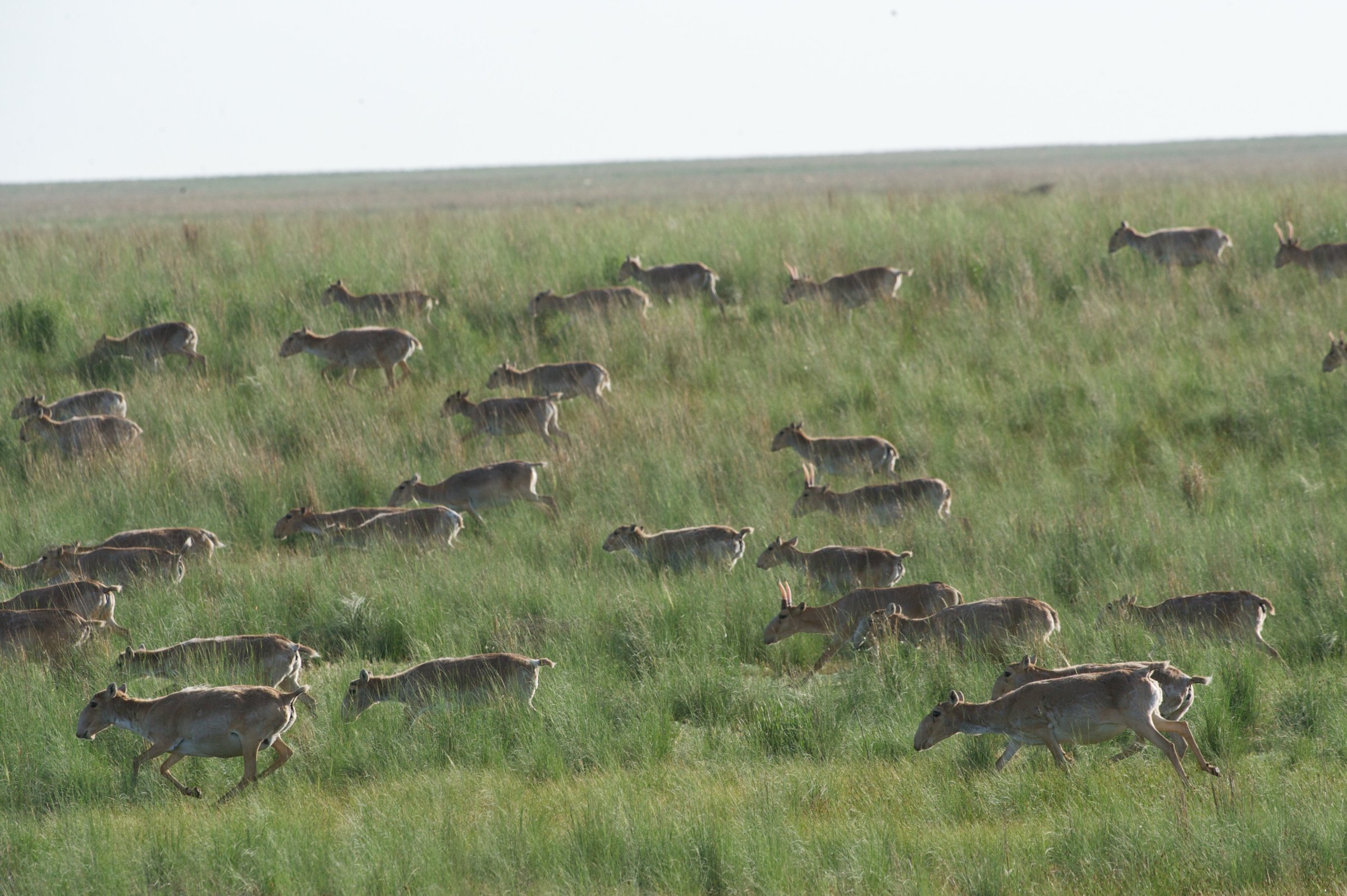 Photo: Valerie Maleev
Behaviour & migration
Life on the move
Saigas are nomadic, migratory antelopes that travel several hundred kilometres between seasonal ranges, moving towards fresh vegetation in summer and areas with less snow in winter. Within these ranges, they roam in response to changing food and weather conditions.
Their social structure also changes throughout the year. During the winter breeding season, males form groups of females known as harems. In spring, pregnant females gather in large calving aggregations, sometimes numbering in the tens of thousands. Calving is highly synchronised, with most calves born within about a week.
Distribution
Where saigas live
Saigas once ranged across much of the Eurasian steppe. Today, their wild populations are concentrated in Kazakhstan, with smaller populations in Mongolia, Uzbekistan, and Russia.
They inhabit open steppe and semi-desert landscapes, where access to seasonal grazing and water shapes their movements. Their need for space makes connected habitats especially important.
Two subspecies survive today: the nominate saiga (Saiga tatarica tatarica), found in Kazakhstan, Uzbekistan, and Russia, and the Mongolian saiga (Saiga tatarica mongolica), found only in western Mongolia.
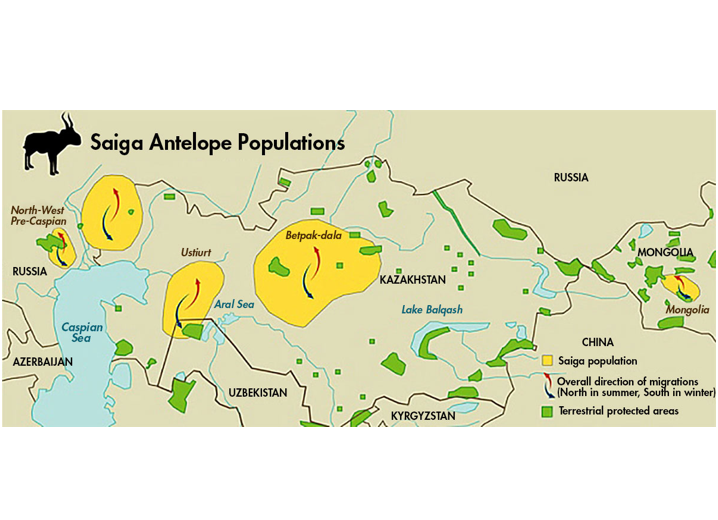 Photo: Convention on Migratory Species
Wild saiga populations are concentrated in Kazakhstan, with smaller populations in Mongolia, Uzbekistan, and Russia.
Explore further
Learn more about saigas
Support our work
Help keep saigas on the steppe
Every donation contributes to vital conservation work, from protecting saigas in the wild to advancing research, education, and international cooperation.
Your support helps make saiga conservation possible.