
Project
CMS Saiga MoU Coordination
International cooperation has been central to saiga conservation for the last two decades. Saigas cross national borders, are affected by international trade, and face threats that no single country or organisation can tackle alone.
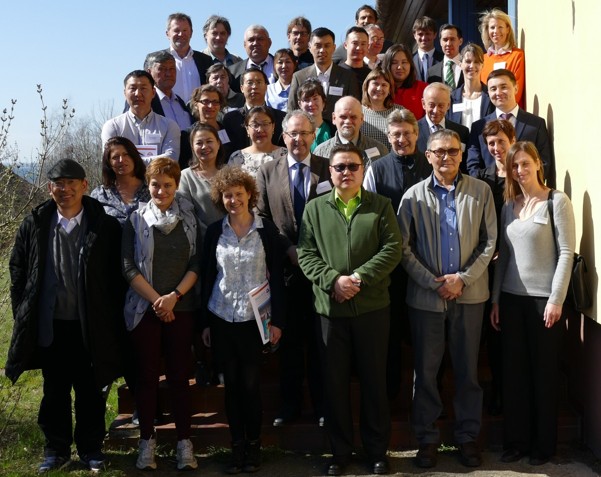
A major step came through the Convention on Migratory Species, when range-state governments and conservation experts came together under the Saiga Memorandum of Understanding. The MoU provides a shared international framework for saiga conservation, bringing governments, NGOs, academics, funders, and other partners together around agreed priorities and coordinated action.
SCA became formally involved in this process in 2010, when we joined the MoU as a Cooperating Organisation alongside other international conservation organisations and the IUCN Species Survival Commission. At the same meeting, SCA and the Association for the Conservation of Biodiversity of Kazakhstan were appointed as technical coordinators for the MoU.
Since then, SCA has helped facilitate the exchange of information between governments, researchers, conservation organisations, and other partners across the saiga range. This has included contributing technical expertise to international meetings, helping draft key documents, supporting workshops, sharing research and project information, and keeping the wider conservation community connected between formal meetings.
The MoU is supported by a Medium-Term International Work Programme, which sets out agreed conservation actions in five-year cycles. SCA has helped partners share progress against these priorities and connect practical work on issues such as monitoring, disease, trade, habitat, and community engagement with the wider international process.
SCA has also helped strengthen communication through the Saiga Resource Centre and Saiga News, making information, research, project updates, and conservation experience accessible across the range. We have supported international policy discussions beyond the CMS process too, including CITES side events and technical work on issues such as the sustainable use of saigas.
More recently, the Central Asian Mammals Initiative has provided a broader umbrella for coordinating work across migratory species in the region, helping identify shared solutions to challenges such as linear infrastructure and habitat fragmentation.
The strength of the Saiga MoU lies in the community around it. Governments, NGOs, researchers, funders, and practitioners have been able to agree on priorities, share evidence, and report progress through a common framework. SCA’s role has been to help sustain those connections and ensure that technical knowledge and experience from across the saiga range can feed into international decision-making.
Year by year
Key project milestones
Explore the project’s journey over time. Click each year to discover key activities, developments, and milestones.
Since becoming a technical coordinator for the Saiga MoU in 2010, SCA has continued to facilitate information exchange, contribute technical expertise, support international meetings and workshops, and connect specialists across the saiga range.
By 2015, SCA had spent years helping strengthen connections between researchers, veterinary specialists, NGOs, government partners, and others working on saigas across the range.
When more than 200,000 saigas died in Kazakhstan’s Betpak-Dala population, those relationships proved their value. Information could be shared quickly, specialists could be connected across organisations and countries, and different kinds of expertise could be brought together more effectively.
For SCA, the crisis demonstrated the practical importance of the international network and communication channels that had been built up over the previous decade.
SCA and ACBK developed practical tools to support the MoU between formal meetings. This included improved reporting mechanisms, databases of experts and projects, and the Saiga Resource Centre, which brought together CMS documents, research, project information, educational materials, and the archive of Saiga News.
The aim was to make international cooperation more continuous and useful, rather than relying only on periodic meetings.
At the second meeting of Signatories to the Saiga MoU, SCA formally joined as a Cooperating Organisation. At the same meeting, SCA and the Association for the Conservation of Biodiversity of Kazakhstan were appointed as technical coordinators for the MoU.
This gave SCA a formal role in facilitating information exchange, bringing technical expertise into international discussions, and helping connect governments, NGOs, researchers, and other partners across the saiga range.
Related work
Explore similar projects
Support our work
Help keep saigas on the steppe
Every donation contributes to vital conservation work, from protecting saigas in the wild to advancing research, education, and international cooperation.
Your support helps make saiga conservation possible.