
Project
Participatory Monitoring of Saigas
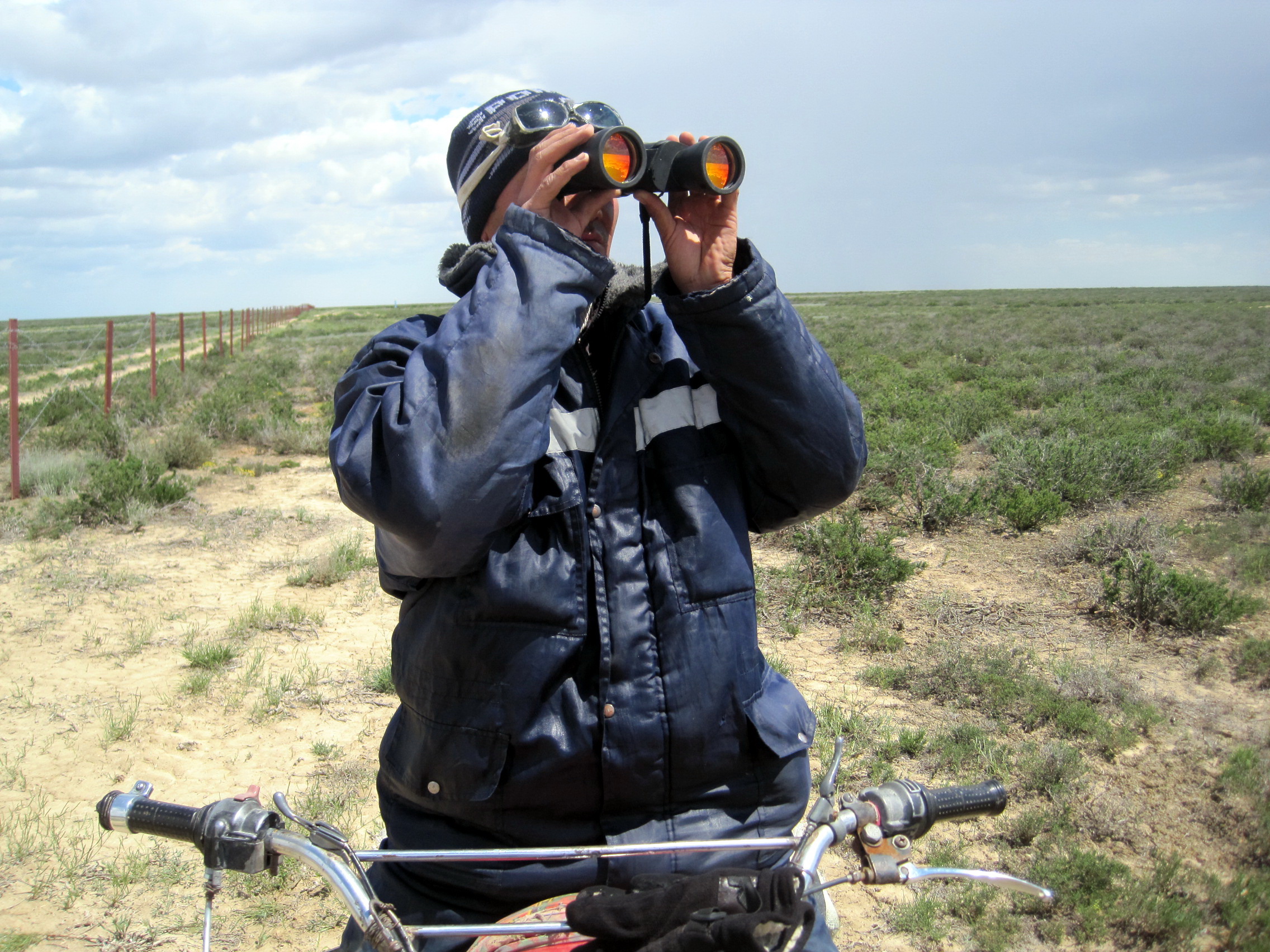
Saigas range across enormous steppe and desert landscapes, making them difficult to monitor using conventional surveys alone. Herds can move over long distances, populations may be widely dispersed, and repeated expert surveys are expensive and difficult to sustain. SCA and its partners developed participatory monitoring as a way of adding another source of information: enabling people who lived and worked in saiga landscapes to contribute directly to monitoring.
The strongest and longest-running strand developed in Kalmykia, Russia. In response to low saiga numbers, limited conventional monitoring, and continued poaching pressure, the Centre for Wild Animals of the Republic of Kalmykia, with support from SCA and international partners, established a monitoring network in which people working across the steppe recorded saiga sightings during their everyday activities. The programme had two explicit aims: to generate useful information for conservation management and to strengthen local involvement in saiga conservation. Across three successive projects between 2008 and 2012, records were held from 48 monitors spread across the landscape.
Analysis of these records provided information on changes in herd size, frequency of sightings, and saiga distribution at a time when reliable information on the north-west Pre-Caspian population was difficult to obtain. Research also examined who participated, why they became involved, how information moved through local social networks, and how monitoring could be made more effective. The work showed that participatory monitoring had limitations, but could generate valuable, relatively low-cost information for conservation management.
SCA and its partners applied related approaches on the Ustyurt Plateau in Uzbekistan. There, repeat transect surveys were combined with observations and knowledge from local residents. This helped build a longer-term picture of saiga decline, poaching pressure, distribution, and changing migration patterns. Local observations became particularly important when formal transects detected very few animals, providing additional evidence of where saigas were still occurring across the wider landscape.
Monitoring and community-based conservation work were also supported in Kazakhstan as part of SCA’s wider range-wide programme. However, the surviving archive does not document a distinct Kazakhstan participatory-monitoring programme at the same level of detail as the work in Kalmykia and the Uzbek Ustyurt, so those two programmes remain the main focus of this page.
The programme also helped build monitoring capacity within conservation institutions. Local monitors worked alongside researchers, while Saigachiy Reserve rangers were trained in survey methods, GPS use, camera trapping, and data collection. Together, this work demonstrated how people living closest to saigas could contribute information that conventional surveys alone could not provide, while becoming active participants in their conservation.
With thanks to our funders
This work was supported through different phases by the Rufford Foundation, Whitley Fund for Nature, People’s Trust for Endangered Species, U.S. Fish and Wildlife Service, and other supporters of SCA’s community-based conservation work.
Project partners
This work involved the Centre for Wild Animals of the Republic of Kalmykia, the Institute of Zoology of the Uzbek Academy of Sciences, Saigachiy Reserve, local researchers, rangers, conservation organisations, and community monitors across the saiga range.
Year by year
Key project milestones
Explore the project’s journey over time. Click each year to discover key activities, developments, and milestones.
Saigachiy Reserve staff increasingly became part of the monitoring system. In 2017, seven reserve staff joined a saiga transect survey and received training in GPS use, camera traps, survey methods, and field data collection. This helped transfer monitoring skills into the protected-area team and linked community-based monitoring more closely with reserve management.
Participatory monitoring continued alongside work on Saigachiy Reserve, illegal hunting, and the Kazakhstan-Uzbekistan border fence. In 2017, SCA carried out three rounds of transect monitoring, supporting four local monitors and four researchers.
When formal surveys detected very few animals, information from local residents helped fill important gaps. Between November 2013 and August 2014, local informants reported 181 saigas, providing information from areas and periods not fully covered by formal transects.
On the Uzbek Ustyurt, repeat monitoring documented an alarming fall in saiga observations. Comparable surveys recorded 440 saigas in May 2012 and only 24 in May 2014. Monitoring helped demonstrate the severity of the population decline and highlighted poaching and disruption of migration routes as major concerns.
Research by Leejiah Dorward critically evaluated the Kalmykia programme, looking at both the ecological information it generated and its influence on participants. The study concluded that participatory monitoring could provide valuable and cost-effective information for conservation management, while identifying ways to improve the selection and support of monitors.
The Kalmykia programme continued through successive projects supported by the Rufford Foundation and U.S. Fish and Wildlife Service. Across the programme, records were held from 48 monitors. Their observations were used to examine changes in herd sizes, sighting frequency, and saiga distribution across the landscape.
With conventional monitoring struggling to provide sufficiently detailed information on the north-west Pre-Caspian saiga population, the Centre for Wild Animals of the Republic of Kalmykia, with support from SCA and international partners, established a participatory monitoring programme. People working on the steppe recorded saiga sightings as part of their normal activities, creating a dispersed network of local observers.
Related work
Explore similar projects
Support our work
Help keep saigas on the steppe
Every donation contributes to vital conservation work, from protecting saigas in the wild to advancing research, education, and international cooperation.
Your support helps make saiga conservation possible.